This Saturday was a big day on 290 for me. The focus of my day was San Antonio's
Culinaria event
Rambling Rose' at Becker Vineyards (coming up in a post later this week). Afterward, we headed back down the road to take the tour at
Grape Creek Vineyards. Sean and I took advantage of their online special -- tasting and tour for $15. This tour was educational -- much like
Wine Words from Jeff, a regular Facebook post from Grape Creek -- and fun. By the time I left, I knew a bit more about wine and a lot more about Grape Creek.
 |
| The tasting rooms and courtyard at Grape Creek |
Quick Tour Info
Special: Through today, visitors to the website can purchase this great offer ($15). Normally the
barrel tour is $20 with an additional tasting fee for $10, making it $30 total. For those wanting to take advantage of this special, it must be done
TODAY, Monday, August 13 and online. One advantage though is that the certificate is good for any day and any time during August, meaning there are two more weekends and a total of eighteen days to take the tour.
Basics of the Tour: Guests hop on a tram to drive by the vineyards where they are dropped off at the crush pad. From there, a lesson on the crush occurs before heading into the tank room. After that, guests visit the barrel room where they get to taste the same wine from three different types of barrels. If the tour includes a tasting, guests move into a section of the barrel room where they enjoy the normal Grape Creek tasting but done in private with the group. This entire journey lasts about an hour.
A Saturday Afternoon Tour
A quiet vineyard
means a bustling winery:
grapes change into wine
We left the beautiful Tuscan patio near the Grape Creek tasting rooms at 3 p.m. The summer sun didn't stop the small group of eight from getting on the tram. Our guide, Gordon, pointed out key areas of the vineyard as we drove by, especially the Montepulciano, harvested the week before, and the Aglianico. These two Italian varietals are combined at Grape Creek to make their Epiphany wine; Gordon told us that in Italy, this blending is not allowed, making Grape Creek's wine a unique one.
 |
| A picked line of vines |
The Crush Pad
As we came upon the crush pad, we were provided a little history. Grape Creek is one of the oldest wineries on the 290 trail. But the Grape Creek many now know and love is not the same one. In 2006, Brain Heath bought the winery and moved it forward. I remember the winery back around the change. The tasting room, now part of the B&B, only held about 10-12 people before it became uncomfortable. Besides the space, I also felt uncomfortable visiting, and the wines didn't draw me back. Sean and I made a return visit (four years later) in 2010, and found the wonderful winery that Brain helped to build. The entire area has been expanded: two beautiful tasting rooms, patio/courtyard, and a new production facility. While the old tasting room is now the B&B, the old production facility, with space below it, is now the barrel room. The expansion was also in varietals, as the winery switched to more Texas friendly grapes and unique blends. And of course the addition of Jason Englert as winemaker aided the winery. Now, there is a lot more here; and best of all, this is a friendly and beautiful location with great wine.
 |
| Merlot debris post-crush |
At the crush pad, we got a chance to see the remnants of the de-stemming and crush of estate Merlot (done that morning). The residual debris from the harvest rested in the blue bins: stems, leaves, and small berries. Before our crush lesson, we were informed that Grape Creek likes to rely on their estate grapes, but also purchases grapes from Mason and the High Plains; about 80-85% of the grapes they use are from Texas. They do have one non-Texas grape; their Reisling is purchased from a vineyard in New Mexico.
 |
| Gordon explaining the crush process |
This lead into the crush process. At Grape Creek, they start with one machine to loosen everything up. From there, the grapes are removed from the stem. The machine used for this starts by having the heavier items -- in this case the grapes -- fall through a grate and drop into a bin below. After that, the grapes and juice are separated. A machine uses a bladder to press the grapes so that the clear juice can come out and be piped off to a holding tank. In the case of red wines, the skin is kept around to add color, flavor, and tannins. As of right now, Grape Creek can process 10,000 pounds an hour.
The Tank Room
We were then ushered into the tank room and wine facility, which is going strong on its second harvest (one of the newest members of the Grape Creek family). Since it came online, it has doubled Grape Creek's production. In the tank room, we were able to get a look at the tanks in action -- one was covered with frost. The liners on each tank -- the bumpy texture -- is actually what is used to control the temperature of the wine during fermentation. At Grape Creek, they send the wine down to 24 degrees for 12-72 hours in order to kill the yeast. Gordon provided a neat fact at this point that Louis Pasteur didn't come to this technique from working with milk but with wine (and some of his other techniques were learned by experimenting with beer, or so many of the TexSom tweets seemed to say). After this, they add a yeast that best suits the varietal in the tank to help with fermentation.
 |
| Learning about tank fermentation |
It is in the tanks that the skin and no skin issue is resolved. For whites, the skin is not kept around. But in order to add color to the rose's and reds, the skin is needed. For rose' wine, the skin is kept around for 6-7 days, but for red wine, it is kept around for 7-9 weeks.
The tank process continues depending on the wine. For a lot of whites, many wineries will keep it in the tank through the entire prcoess, staying in for 11-15 months. Some whites will be moved to barrels -- Chardonnay is often barrel-aged -- but most will stay in the tanks at Grape Creek. The reds don't spend much time here. Normally, they keep the reds in tanks for 10-12 weeks (and of that, only 1-5 are without the skin). From there, the reds move on to resting in the barrels where they will age.
At Grape Creek we saw another building/room but did not enter it. The recovery room is used to store wine after it is bottled. They keep this room set at a constant 67 degrees to help avoid bottle shock. How long it stays in this important resting place will depend on the wine. All of this is a necessity for good wine straight from the bottle, as bottle shock can damage a wine. In the movie
Bottle Shock, the Chardonnay in question turns brown because of the light exposure to oxygen the wine got while being bottled. Luckily for them, it just needed time. After the wine recovered, it was beautiful, clear, golden wine. To avoid this and similair probelms, Grape Creek stores their wines for a bit after bottling.
The Barrel Room
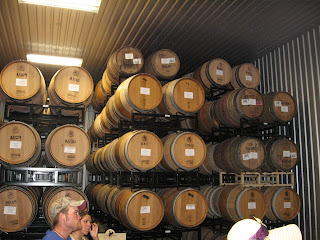 |
| The imposing barrel room at Grape Creek |
As we stepped into the barrel room, the racks of full barrels loomed over us. We learned there was more in a downstairs facility, and we would later find out that there were more barrels hiding behind a sliding door. At Grape Creek they use three types of barrels -- American Oak, French Oak, and second vintage American Oak (aka used once before). All the barrels are toasted on the inside. This technique can add flavor and sugar to the wine, and it is used by other neighboring wineries like
Becker. What was great about this part of the tour was the lesson in how the barrels were different and how they affect the wine.
 |
| Three barrels -- American, French, and second vinatge American oak -- of Cabernet Franc |
Barrel Characteristics:
- American Oak: These $600 barrels are easy to acquire. They are ready to go and tend to do best when used to age wine 11-15 months. They are also good to use a second time (and Grape Creek does that).
- French Oak: The $1200 price tag is a result of transportation and growing (the trees used for the barrels take longer to grow than American Oak). However, this growth is great for aging wine, as the tighter grain positiviely affects the wine. These barrels are best used to age wine 15-24 months.
 |
| Cabernet Franc |
In order to help us see the differences in effects, the tour has a comparison tasting of the same vintage from three barrels. We were tasting a Cabernet Franc that was put in the barrels in late December of last year, where it will stay for at least a six more months.
- New American Oak: This wine was the earthiest of the three. The wine was strongest mid-palate and focused on the richer flavors of smoke, earth, and minerals.
- Second Vintage American Oak: This one was the most fruity of the three. The fruit was strongest on the aroma, but strong alongside the earthy flavors that were more powerful in the aftertaste. This one was showing interesting complexity, making it one to watch for in the future.
- French Oak: At this point, this barrel provided the most balanced and clean wine. In the aroma, the fruit is more pronounced than the earthier flavors, but the two are smoothly combined and mingle more during tasting. At this stage, this is the one I would likely drink right now.
 |
| Private tasting with Gordon and Shawn |
As we were on the special tasting tour, Sean, I, and our group were brought into an adjoining barrel room to enjoy a tasting of six wines. We moved towards the end of the table and found oursleves being lead through the tasting by one of Grape Creek's wine club members, Shawn. She told us that she helps out from time-to-time because Grape Creek is her favorite winery; that and they pay her in wine. She provided an enthusiastic journey through the wines, sharing stories of Grape Creek and her other wine experiences. I have to admit that I love doing tastings in groups. In a group, you can get great ideas from others, but you also get to share. Every group tasting I have been a part of ends up getting loud, filled with stories and laughter. That is exactly how this time ended, and I couldn't be happier.
 |
| Jeff and I in the tasting room |
After returning back to the hustle and bustle at the main tasting rooms, I did get to end my day with a very special meeting. Gordon introduced me to Jeff, the wine educator of sorts at Grape Creek. It was a delight to finally meet him in person after regularly following his Facebook posts (if interested, just like Grape Creek on Facebook). I also got to meet the vineyard manager. She informed me that they have been very busy as of late, but things seem to be calming down. These last two introductions topped off a great expereince that I think I will do again soon.