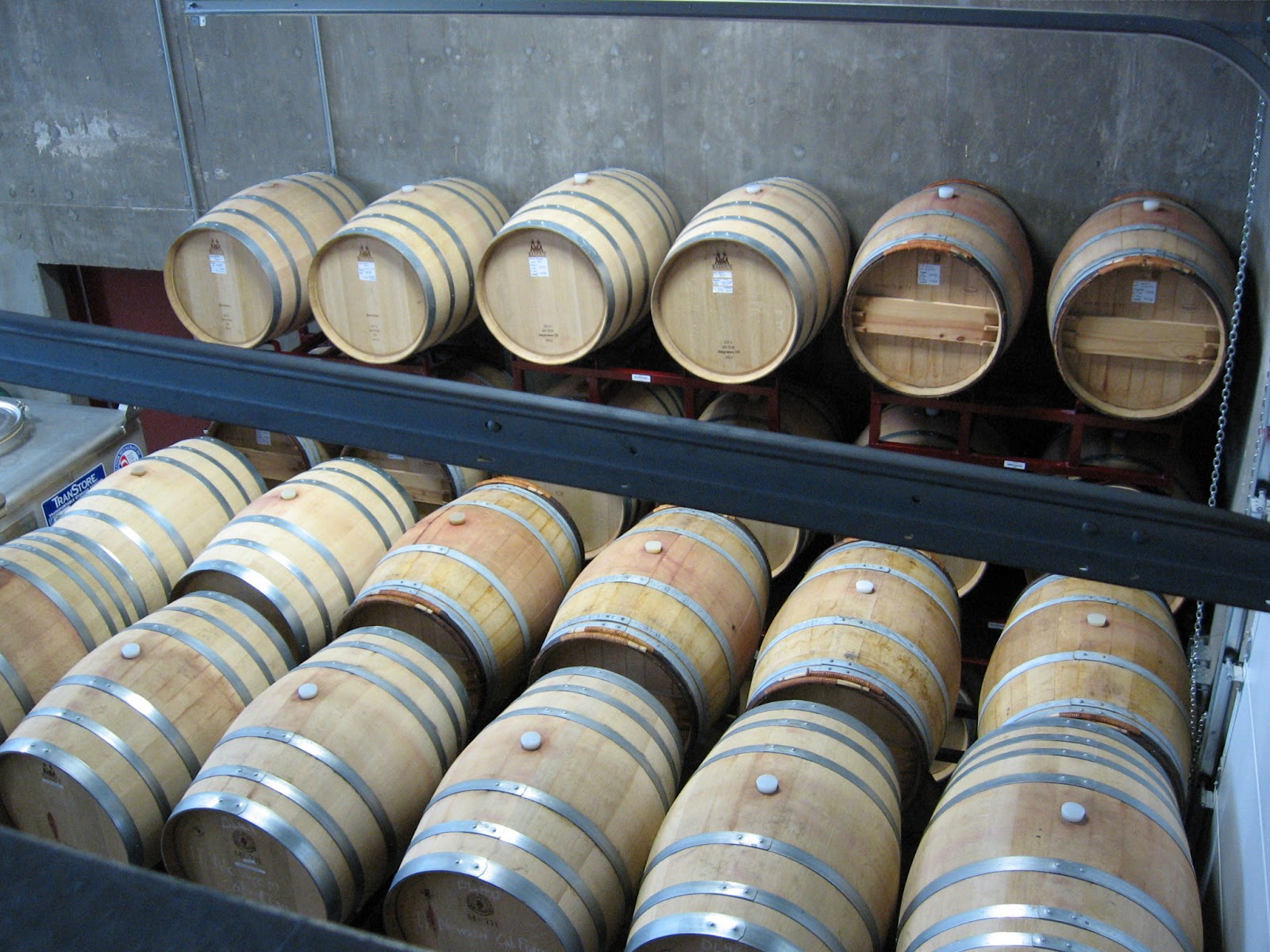
For months, I had been trying to finally visit Lewis Wines. I had known about it as early as last Spring, and then late in 2012, Chris Brundrett (of William Chris Wines) mentioned he was headed out there for a pre-opening tasting. Due to a snafu, Sean and I didn't get to tag along. Flash forward to Spring 2013, and everyone is eagerly awaiting the official opening; that is when I heard they were doing appointment only tastings. I tried to arrange one, but they weren't available. I tried again, only to not make contact. Finally, on a Saturday evening, I called owner Doug Lewis to finally make my appointment.
I'll admit, it has been nearly a month since that visit. I have had a hard time to writing this up; getting to this post was difficult. The visit was not the problem; the tasting and visit was great. The problem was with what happened later in the day. A difficult family situation got out of hand and became a real mess. It's been hard to write about something so great with the shadow of what came later hanging over it. Now, I'm ready to move on and finally get to one of the most inspiring winery visits I have ever had.
 |
| Doug Lewis (to the back in the cap) and Duncan McNabb (red shirt) providing a group tasting |
When Sean and I arrived, Duncan McNabb, Doug's partner, met us at the door. His partner, Doug Lewis soon joined us. I was surprised as I looked at these two new Texas winemakers: they were young. Now I have gotten used to the Texas wine industry getting younger, but younger meant closer to my age -- thirities. When I looked at these two, I realized they were old enough to have been my students. I was right; Doug admitted to being only 26. This took me back for a moment, but when I put it into perspective, I realized this was a good thing. Our next generation of Texas winemakers are starting out, trying to master their craft and experiment. This is a sign of a robust industry, one with a future. And after what I tasted, I knew the future holds great promise.
During my tasting, I talked to Doug, trying to get an idea how he came to wine. I don't care what people say about the Millennials getting into wine; I don't see the numbers to support the idea. When I am visiting wineries and wine club events, the visitors are getting younger, but most are still older. And when I talk to my older students -- those in their twenties -- most don't even drink wine. So, Doug had to have acquired a taste for wine somewhere, and I was curious where. As I found out, it was one of my favorite places, Pedernales Cellars. Doug got his hands dirty helping out manager Jim Brown and winemaker David Kuhlken. While Doug was there, he began to experiment with wine. Before long, Pedernales Cellars was giving him the connections and knowledge he needed to start his own winery.
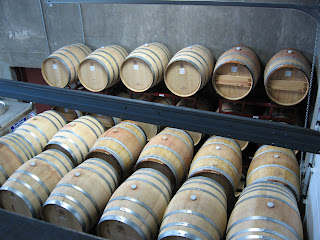 |
| The future of Texas wine: barrels at Lewis Wines |
And one of the most valuable connections Doug got was Texas grape growers. Doug knew who were the top grape producers in the state, and even knew how to get a hold of him. It even gave him direct lines to highly sought grapes. Doug recounted one time when one High Plains grower was a bit leery of selling his grapes to a new winemaker. Luckily, Doug had the best references he could get and scored himself incredible grapes. His connections have also allowed him to get some of the limited and prized Touriga. After a recent visit to Spicewood Vineyards, Brad Dixon told me how hard it is to get Touriga. When I heard that, I knew Doug's supply was a rare commodity.
And the work Doug and Dave are doing on their little slice of 290 is something to behold. To be honest, Sean and I are on a VERY tight budget. We went telling ourselves we really shouldn't buy any wine, for now. That rule didn't hold; we left with three bottles, buying three of the five wines available. Doug and Duncan are producing wines that suit Sean's and my pallets quite well. These wines show a growing mastery of the grapes but also a great playfulness. In fact, that playfulness is what stands out with these wines. I found many of the wines we tasted to have something unique about them, setting them apart from similar wines produced throughout the state.
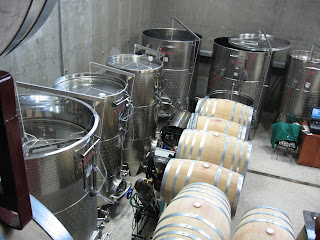 |
| Where the whites were at the time of our visit |
As of our tasting, the whites were still in the barrel, growing and maturing. The whites are excellent examples of Texas Viognier. The 100% Viognier made from Binghman Vineyard grapes was a crisp white with a nice hint of acid. The nose and the taste was smooth: a consistent, a bouquet of citrus tones with an emphasis on pineapple. Take this same great varietal and make it 52% Viognier and 48% Chenin Blanc, and the bright crisp wine becomes one that is soft and cooler, a easy sipping dry white. This second white was more subtle, but it also highlighted the sweetness inherent in the citrus. The 100% Viognier would make a great pairing wine, bright and clear. The second, with its more laid back character, makes for a great end of the day sipping wine.
When we moved on to the reds, I knew something wonderful was coming up. Viognier is one of those whites for red drinkers; well done Viogniers often translate into strong reds. That was again the case here. I beamed from ear-to-ear when I saw the Texas Malbec. The grapes from this terrific wine came from Neal Newsom. When Doug went up to get the grapes, we had to hand pick them. Well, he was in luck. A family of Mennonites aided in the harvest; they actually picked more than Doug and the others with him. As for the wine, it was rich, earthy full bodied Malbec -- aided by a hint of Petite Verdot. The wine made my think of the darker Argentinian Malbecs. Of course, this was one of the bottles we brought home.

Neal Newsom provided grapes for the Lewis Wines' Cabernet Sauvignon. I had, for awhile, turned away from this perennial red. However, I began to think twice when I had the Newsom Cab from Becker vineyards. And then came the Bending Branch Newsom Cab (San Francisco award winning Cab by the way), and on and on and on. I came back to Cab because there is something about those Newsom grapes. And this recent addition to that tradition is another great example. This wine had a smokiness that is so often lost in smooth Cabs; this less fruity tone makes it stand out.

As I mentioned earlier, Lewis Wines has scored a major coup. They have Mason County Touriga Nacional (they have now gotten the grapes from Round Mountain, whom I am guessing had once been Spicewood's provider). Touriga is such an exciting grape. Every Texas wine I have had it in --- most blends -- have remained favorites. From my first taste with Sandstone, to my growing appreciation with Persissos, and now all of my recent forays -- Fly Gap, Spicewood -- I am enamored. The 2010 Texas red wine is a blend of 50% Touriga, 33% Tempranillo, and 17% Tinto Cao. This unique blend has a complex nose that contrasts from flavor of the wine; the nose is strong with a powerful sense of dark berries and fruit, but the taste is less so. The flavors are currently muddled in the wine. The beginning is a light, gentle taste that grows. By the middle, the wine struggles to bring forth the three grapes. And at the end, the wine smoothes out and and becomes a harmony of flavors that leaves one glad they took the journey. We bought a bottle to let it age a bit, as I think the wine has great potential but needs to mature a bit.

Lewis Wines had two top red blends from 2010 grapes. The other is more Tempranillo (55%) paired with 35% Mourvedre, 8% Syrah, and 2% Grenache. This wine provided a bold, fruit flavor that makes great use of the non-Temp grapes. In addition to this Temp blend, there was a 100% Tempranillo sourced from Kuhlken family vineyards and Bingham vineyards. I expected an earthy Temp, like what is normally found from Pedernales Cellars, but was happily surprised to taste a more nuanced one, one with more fruit, a softer touch on the earth and spice and brighter with the fruit. Of course, it is with the touch that brings out the softer side of Tempranillo that can create the blend.
 |
| A field of wildflowers on the road from the winery back to 290 |
New Wine
Red, yellow, with hints
of purple stretch out above
tall grasses, age old dirt.
All I can see: a fresh look
springing forward to tomorrow.
I enjoyed the visit to Lewis Wines. Duncan and Doug are so friendly and welcoming. And their wines feel just the same. These aren't the powerhouse red wines coming from some of the Texas wineries. These wines are welcoming ones; ones that younger wine drinkers can be introduced to and find their way. And for we more experienced wine drinkers, they are a "Howdy" and a smile that allows us to sit back and relax into the wine. This is a bright new future for Texas wine.
.JPG)
.JPG)
.JPG)