Showing posts with label Viognier. Show all posts

Tuesday, August 13, 2013

A Different Take on Old Favorites: Visiting Spicewood Vineyards

I don't often venture much past the 290 wine trail here in Texas. I have to do almost all my winery visits as day trips, so staying near home is easier. But that regular circuit of wineries doesn't always inspire me. When there are new wines, events, etc., it is easy to get inspired, but as the days turn long and the winery folks are intent on the grapes ripening on the vine, I look for different pastures. I start close, usually the Driftwood/Dripping Springs area. Recently I went a tad bit further afield and stopped in the Marble Falls area. Sean and I hadn't been to the area wineries in several years; our last visit was right after my grandparents moved from Lago Vista in 2011. On a nice, bright June Saturday, we visited Spicewood Vineyards.


Visting
We visited Spicewood back in 2011. At the time, we found the wines decent but lacking some character. We decided to file the winery away and wait to see what happened. Recently, the folks at Vinously Speaking made a visit to Spicewood. There were tales of good times and great wine; and with that said, Spicewood wines ended up on the shop's shelves (The Tempranillo, Merlot, Merlot Rose, and Sauvignon Blanc). This peaked my interest, and so we made the slightly longer drive up 281.


The winery was a bit quiet for a Saturday afternoon -- there were three other small groups besides us. We didn't mind, as they left before we finished, giving us ample time to chat with vineyard manager Brad Dixon and owner Ron Yates. Brad took us through a leisurely tasting as we enjoyed the company of the three winery dogs.We mainly tasted the available menu, but at the end, we were able to taste a few more wines. This tasting was what we had hoped for two years ago. All the wines are small production and use primarily Texas grapes (grape appellation is notated on the tasting menu). The wines also had their own voice, each with its own take on the mainly single variety wines.

Wines
Estate Vineyards

The whites were a nice treat. The two we tasted were two of my favorites, Viognier and Albarino. For both, the grapes came from the Texas High Plains; the wines also provided light, subtle takes on the grapes. The Albarino had strong notes of pear with a crisp finish. This was a surprise, as I often expect a hint of sweet in Albraino; instead, I found it in the Viognier, as the aroma of honeysuckle and tastes of melon came through.
Wines for sale at Vinously Speaking, San Antonio, Texas 

Spicewood has a number of roses. The one we tried was the Tempranillo. I first worried that is would resemble the Rose of Tempranillo from Hilmy, but it was a dry rose compared to Hilmy's slightly sweet. Both roses bring out hints of strawberry, but as the Spicewood wine is dry, the strawberry was light, almost floral. 

One of the main reasons we came to Spicewood was their Claret. Sean still stands by Becker's Claret -- even if oftentimes the grapes are not from Texas. Knowing that Spicewood is known for their Claret -- they even have an annual Claret chili cook-off in March -- we were eager to give the newest one a try. This Claret, despite being dominated by Tempranillo (at 55%), is oddly sweet. In fact, I noticed attributes of the other grapes -- 27% Cabernet Sauvignon, 13% Merlot, and 5% Syrah. The fruit notes are very pronounced and give a sense of sweetness not found in Claret. 

We drank one non-Texas wine, the Grenache from Paso Robles, CA. The nose on this wine reminded me of a Spanish version of this wine, oak and earth. I expected the wine to be more fruity and light, as the variety is often a light-bodied red (check out Becker's Reserve for a good example). However, this Grenache provide depths of flavors with an oak feel mid-palate and ending with a balance of tea and fruit. This unique red asked me to take my time and taste it carefully.


Wines for sale at Vinously Speaking, San Antonio, Texas
We rounded out the main tasting with a High Plains Tempranillo (80% with 20% cCb) and an estate grown  Hill Country Merlot. The Tempranillo hearkened back to the Claret; it was light and fruity with only a hint of the typical spice and earth so often found in Texas Tempranillos. It had hints of the typical Temp found laced through a lighter, fruitier take; I could easily just sip at this wine. The Merlot was the only wine I didn't feel surprised by; it fell in line with many of the Texas Merlot's we had recently been tasting, which is a good thing. The tannins were pronounced in the aroma, leading into flavors of spice and limestone; the fruit was light and interlaced itself through the stronger earthier flavors.

After our main tasting, Brad offered to let us re-taste or taste other wines. Of course, Sean and I were both drawn to the 100% Touriga. Brad informed us that they had been tending the Touriga -- located in Round Mountain -- for someone else. For taking care of the grapes, they got access to the crop. This wine was the result of that hard work. It ended up our favorite of the day. It was a lighter, softer Touriga, especially compared to the ones coming out of  Mason, TX (one of the areas producing the most of it). The fruit flavors, dark berries, dominated but were well supported by spice and earth (the opposite of what we were use to). The balance found in this wine was incredible. We were blown away, and then disappointed. This past year, the owner of the vineyard decided to start charging Spicewood, and they were not interested in the new price. This means no Touriga in the new future. However, the success of the vineyard encouraged them to plant some of their own; that means there will be Touriga again several years from now. 

Painting found at the winery
This recent trip to Spicewood won us over. This was something different, despite the same old varieties. I like to taste the depth and breadth of a grape, to know its various forms. Here, I was provided yet another look at some of my favorites. This year, especially after a trip like this, I have come to appreciate the uniqueness of Texas wines. Different vineyards, different winemakers, etc, craft such a wide range of wines, even when using the same grapes. Because of this, a Texas wine drinker never knows what to expect with each new wine; it is such a wonderful adventure.

Thursday, July 18, 2013

A New Perspective: At Flat Creek Estate

Sean and I took time to visit two wineries in one day. One of those wineries was Flat Creek Estate. We had been here a few times in the past, but were often left a bit unsatisfied. We hadn't been back in over two years, and we weren''t sure when we would make our way further up 281. After some recent tastings at wine events, a Texas Wine Twitter Tuesday tasting, and some chatting on social media with recent Flat Creek winemaker Tim Drake, I thought it was time to head back and give them another try.

Me and Flat Creek

This is a winery with a back story, at least for me; it was one of the first Texas wineries I visited. Sometimes when we would visit my grandparents in nearby Lago Vista (they lived around 20 minutes from the winery), we would stop in. Our first visit with my parents, I think in 2007 or 2008. We made a few other visits, 2010 and 2011, I believe. At those times, we really weren't impressed. The wine always tasted a bit off, maybe a bit overproduced. The wine often left an odd aftertaste. But my dad was a huge fan, so I would go back and try again, hoping it was just the last visit or things had changed. It really didn't. That was until recently.
 
Lake Travis Hill Country at Flat Creek Estates
One of the earlier Texas Wine Twitter Tuesdays featured a Moscato from Flat Creek. I was leery, but was soon enjoying the crisp sweetness of the wine. During that night, I got a chance to ask a few questions of winemaker Tim Drake. I was growing curious. Then Flat Creek was present at Culinaria. I tasted a few of the wines I hadn't had and found them different from the last time I had been at the winery. By the end of the night, I was friends with Tim on Facebook. I was now hooked, and I had to find a time to visit.

Before I get to the visit I have to share an odd side note. Sean and I are amused by the fact that the winemaker is Tim Drake. There is a Batman character with the same name; the second Robin (after iconic Dick Grayson). On our trip out to Flat Creek we couldn't quite help but laugh: Robin was going to Tim Drake's winery. I know, its only funny to comic book geeks.

On Sean's and my recent visit, I had hoped to meet up with Tim, but that didn't happen on the Saturday we came. Instead, owner Madelyn Naber oversaw our tasting and gave us a tour. Everyone at the tasting room was friendly and knowledgeable. I was able to learn a bit more about the current wines and get a fresh perspective on where the winery finds itself at in 2013.

Sean & I in the barrel room

News, Trivia, and Info

There was some neat trivia and info I learned about Flat Creek. Right now, the winery is renting space to a new beverage maker. Mead is currently being made at Flat Creek for sale at different Renaissance festivals; it is nice to see another Texas winery helping someone else out. And like many others, they don't have every piece of equipment in-house. For bottling, they actually rent a truck; I have heard of a number of wineries doing this. Bottling machines and lines are expensive. In addition, the less expensive ones are labor intensive (I should know after volunteering for Hilmy back in March). It is no wonder they just rent when they need to.

There are a number of trends they are working with as well. For one, they are using a variety of fermentation tanks. Though steel tanks made up most of the number, there is some concrete in use; they are embracing a new trend here. In addition, they sell a few wines by the keg and as a growler. Right now, it is mainly just a few whites, especially white blends. Also, they are moving towards screw tops for whites. Their decision here was taste. With a screw top, the wine can taste the same as it did in the tank, retaining the intended flavor. The other cool note was their blending procedure with the whites; they actually blend in a single tank, layering one wine upon another. I found this interesting, and the tank huge.
A variety of tanks, including blending tank (large one in the back)

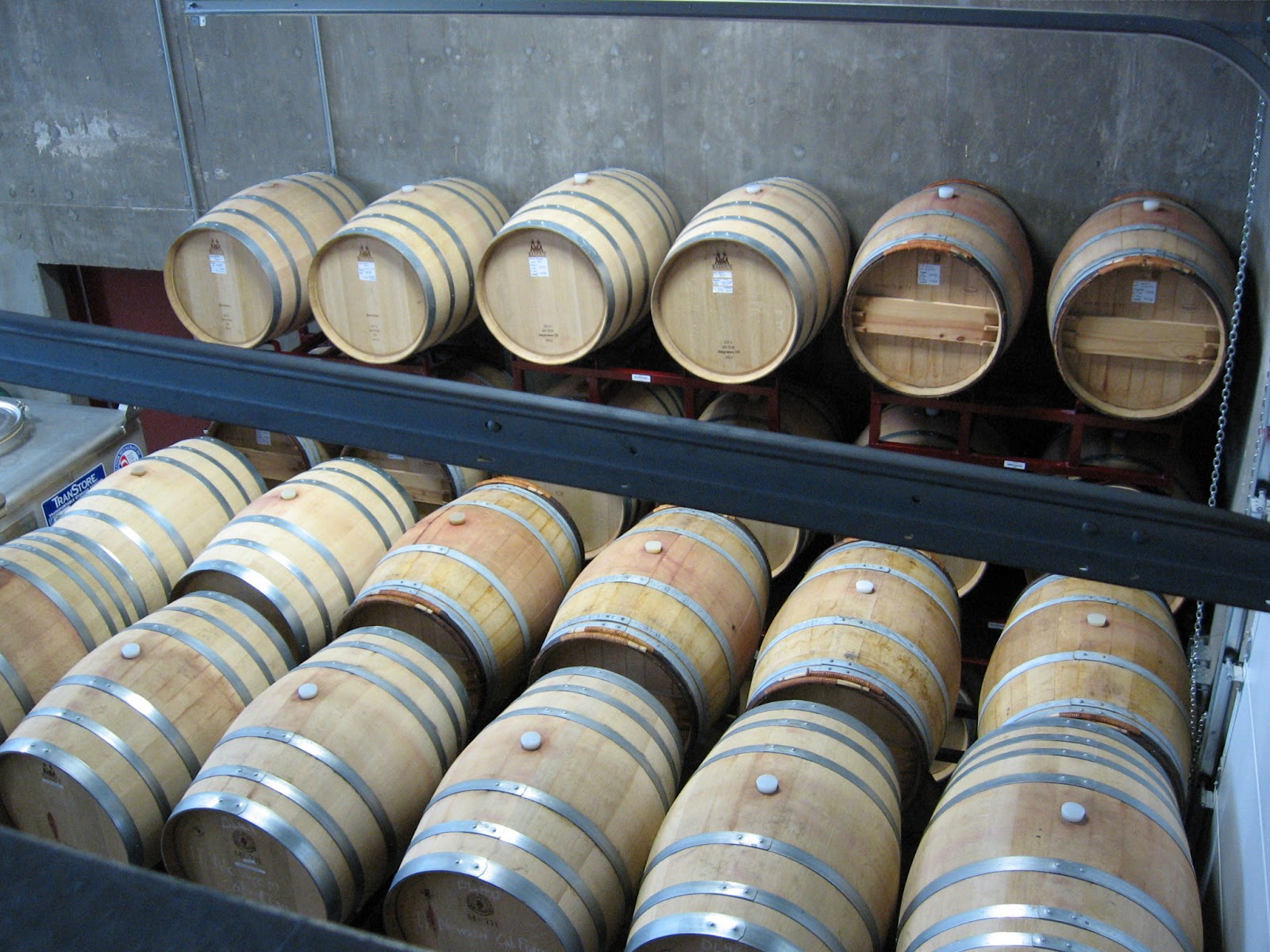
During our tour and visit to the barrel room, we learned a bit more. While sneaking around the barrel room, notating barrels from all over -- France, US, Hungary -- I mainly took notice of the wine and where the grapes came from.  Among the Texas grapes, I saw major grape growers like Newsom and Reddy Vineyards and Andy Timmons' Lost Draw Vineyards alongside Flat Creek Estate Sangiovese and Frio Canyon grapes. I left the barrel room thirsty all over again.

The barrel room -- Lost Draw Vineyards Tempranillo

Tasting

Our tasting was more extensive than most -- Madelyn kept letting us try wines not available to the general public (wine club only) as well as ones that are nearly gone. Of those we tried the 2010 Tempranillo; it was a nice blend of minerals and fruit. We also tried the 2009 Pinotage (made from California grapes). This small quantity wine is no longer available, but a 2010 is one its way. We found this wine to have an enticing character; it blended the fruit and earthier tones well. Sean commented that this wine could make a nice port.

During out tasting we had the older 2011 Viognier. The 2012, which I tasted at Culinaria, won the bronze at an international wine competition in Lyon, France (alongside Becker's silver and Pedernales Grand Gold). The 2011 is a silky wine with strong citrus fruits, especially grapefruit, while the 2012 is more subtle. Along with Viognier, I tasted the 2010 Muscato Blanco, which had a very sweet nose that ended in a sticky sweet taste; it started with softer fruits, like peach, and ended very citrusy (orange specifically). I also had the Mistella, a dessert style Muscat that was orange from the start. This wine was made subtle and soft by the addition of ice and was paired well with dark chocolate.

The tasting room bar; award winning wins and medals on the right

The afternoon's reds included the well known Super Texan (2010), The 2009 Syrah, 2008 Meritage, 2009 Cabernet Sauvignon, and the Port  IV.  The Super Texan is bold on flavors -- earth, spice, oak, and dark fruit -- and yet the mouth feel is light and soft. The Syrah's biggest strength was the tannins that did not stand out but instead accentuate the fruit. The Meritage is highlighted by its oakiness. The wine is a natural progression from fruit to oak. The Cab was a nice balance of fruit and oak. And the port was a ruby style that tasted more like wine than a strong tawny; it was soft and not overly sweet.

Vineyards behind the winery

During our visit we didn't get a chance to eat at the Bistro -- for next time -- but we did end our visit, after our a tour and a bit of wandering in awe in the barrel room, roaming the grounds. This is a beautiful place. I have always held a soft spot for the area; every summer I spent a week or so with my grandparents. The hills that jut and drop away out here, covered in trees and full of wildlife, have always seemed to me like an oasis. The vineyards stretching out and away from Flat Creek work nicely among what was already here. I can see why visitors flock here to escape and drink good Texas wine.


A New Perspective
I always think of golf courses, green
even in the drought and heat of summer,
and the sun sparkling from the lake.
Often, I stared out from the porch
from the house on Madison Cove, 
looking down and out, towards a world 
just out of reach. Below my feet
the Texas scrub and cacti gathered, 
shelter for the deer, skunks, rabbits,
and whatever else would wander 
and scavenge through the yard.
The wind would whistle by
punctuated by hummingbird wings
and the call of the Bobwhite quail.
View of Lago Vista, 5/2010
Estate Vineyards @ Flat Creek, 6/2013


Now, I see the hills rolling away green
with vines and grapes, settling
into this landscape from my childhood. 
I imagine the deer nosing close and the sniffing
noses of skunks as they come through,
only to find their quarry protected 
by shear netting. And from this view, 
I can imagine where Lake Travis sits --
low and sullen from drought -- and barely 
a sparkle visible when it catches the sun;
instead, I see a soft purple gleam
and a light golden twinkle from the sun
slipping through wine glasses.
And I still hear the wind whistle,
a rustle of leaves and soft bird song
drifting along this new vista.


Friday, June 21, 2013

Lewis Wiines

For months, I had been trying to finally visit Lewis Wines. I had known about it as early as last Spring, and then late in 2012, Chris Brundrett (of William Chris Wines) mentioned he was headed out there for a pre-opening tasting. Due to a snafu, Sean and I didn't get to tag along. Flash forward to Spring 2013, and everyone is eagerly awaiting the official opening; that is when I heard they were doing appointment only tastings. I tried to arrange one, but they weren't available. I tried again, only to not make contact. Finally, on a Saturday evening, I called owner Doug Lewis to finally make my appointment.

I'll admit, it has been nearly a month since that visit. I have had a hard time to writing this up; getting to this post was difficult. The visit was not the problem; the tasting and visit was great. The problem was with what happened later in the day. A difficult family situation got out of hand and became a real mess. It's been hard to write about something so great with the shadow of what came later hanging over it. Now, I'm ready to move on and finally get to one of the most inspiring winery visits I have ever had.

Doug Lewis (to the back in the cap) and Duncan McNabb (red shirt) providing a group tasting

When Sean and I arrived, Duncan McNabb, Doug's partner, met us at the door. His partner, Doug Lewis soon joined us. I was surprised as I looked at these two new Texas winemakers: they were young. Now I have gotten used to the Texas wine industry getting younger, but younger meant closer to my age -- thirities. When I looked at these two, I realized they were old enough to have been my students. I was right; Doug admitted to being only 26. This took me back for a moment, but when I put it into perspective, I realized this was a good thing. Our next generation of Texas winemakers are starting out, trying to master their craft and experiment. This is a sign of a robust industry, one with a future. And after what I tasted, I knew the future holds great promise.

During my tasting, I talked to Doug, trying to get an idea how he came to wine. I don't care what people say about the Millennials getting into wine; I don't see the numbers to support the idea. When I am visiting wineries and wine club events, the visitors are getting younger, but most are still older. And when I talk to my older students -- those in their twenties -- most don't even drink wine. So, Doug had to have acquired a taste for wine somewhere, and I was curious where. As I found out, it was one of my favorite places, Pedernales Cellars. Doug got his hands dirty helping out manager Jim Brown and winemaker David Kuhlken. While Doug was there, he began to experiment with wine. Before long, Pedernales Cellars was giving him the connections and knowledge he needed to start his own winery.

The future of Texas wine: barrels at Lewis Wines

And one of the most valuable connections Doug got was Texas grape growers. Doug knew who were the top grape producers in the state, and even knew how to get a hold of him. It even gave him direct lines to highly sought grapes. Doug recounted one time when one High Plains grower was a bit leery of selling his grapes to a new winemaker. Luckily, Doug had the best references he could get and scored himself incredible grapes. His connections have also allowed him to get some of the limited and prized Touriga. After a recent visit to Spicewood Vineyards, Brad Dixon told me how hard it is to get Touriga. When I heard that, I knew Doug's supply was a rare commodity.

And the work Doug and Dave are doing on their little slice of 290 is something to behold. To be honest, Sean and I are on a VERY tight budget. We went telling ourselves we really shouldn't buy any wine, for now. That rule didn't hold; we left with three bottles, buying three of the five wines available. Doug and Duncan are producing wines that suit Sean's and my pallets quite well. These wines show a growing mastery of the grapes but also a great playfulness. In fact, that playfulness is what stands out with these wines. I found many of the wines we tasted to have something unique about them, setting them apart from similar wines produced throughout the state.

Where the whites were at the time of our visit

As of our tasting, the whites were still in the barrel, growing and maturing. The whites are excellent examples of Texas Viognier. The 100% Viognier made from Binghman Vineyard grapes was a crisp white with a nice hint of acid. The nose and the taste was smooth: a consistent, a bouquet of citrus tones with an emphasis on pineapple. Take this same great varietal and make it 52% Viognier and 48% Chenin Blanc, and the bright crisp wine becomes one that is soft and cooler, a easy sipping dry white. This second white was more subtle, but it also highlighted the sweetness inherent in the citrus. The 100% Viognier would make a great pairing wine, bright and clear. The second, with its more laid back character, makes for a great end of the day sipping wine.

When we moved on to the reds, I knew something wonderful was coming up. Viognier is one of those whites for red drinkers; well done Viogniers often translate into strong reds. That was again the case here. I beamed from ear-to-ear when I saw the Texas Malbec. The grapes from this terrific wine came from Neal Newsom. When Doug went up to get the grapes, we had to hand pick them. Well, he was in luck. A family of Mennonites aided in the harvest; they actually picked more than Doug and the others with him. As for the wine, it was rich, earthy full bodied Malbec -- aided by a hint of Petite Verdot. The wine made my think of the darker Argentinian Malbecs. Of course, this was one of the bottles we brought home.


Neal Newsom provided grapes for the Lewis Wines' Cabernet Sauvignon. I had, for awhile, turned away from this perennial red. However, I began to think twice when I had the Newsom Cab from Becker vineyards. And then came the Bending Branch Newsom Cab (San Francisco award winning Cab by the way), and on and on and on. I came back to Cab because there is something about those Newsom grapes. And this recent addition to that tradition is another great example. This wine had a smokiness that is so often lost in smooth Cabs; this less fruity tone makes it stand out.


As I mentioned earlier, Lewis Wines has scored a major coup. They have Mason County Touriga Nacional (they have now gotten the grapes from Round Mountain, whom I am guessing had once been Spicewood's provider). Touriga is such an exciting grape. Every Texas wine I have had it in --- most blends -- have remained favorites. From my first taste with Sandstone, to my growing appreciation with Persissos, and now all of my recent forays -- Fly Gap, Spicewood -- I am enamored. The 2010 Texas red wine is a blend of 50% Touriga, 33% Tempranillo, and 17% Tinto Cao. This unique blend  has a complex nose that contrasts from flavor of the wine; the nose is strong with a powerful sense of dark berries and fruit, but the taste is less so. The flavors are currently muddled in the wine. The beginning is a light, gentle taste that grows. By the middle, the wine struggles to bring forth the three grapes. And at the end, the wine smoothes out and and becomes a harmony of flavors that leaves one glad they took the journey.  We bought a bottle to let it age a bit, as I think the wine has great potential but needs to mature a bit.


Lewis Wines had two top red blends from 2010 grapes. The other is more Tempranillo (55%) paired with 35% Mourvedre, 8% Syrah, and 2% Grenache. This wine provided a bold, fruit flavor that makes great use of the non-Temp grapes. In addition to this Temp blend, there was a 100% Tempranillo sourced from Kuhlken family vineyards and Bingham vineyards. I expected an earthy Temp, like what is normally found from Pedernales Cellars, but was happily surprised to taste a more nuanced one, one with more fruit, a softer touch on the earth and spice and brighter with the fruit. Of course, it is with the touch that brings out the softer side of Tempranillo that can create the blend.


A field of wildflowers on the road from the winery back to 290
New Wine
Red, yellow, with hints
of purple stretch out above
tall grasses, age old dirt.

All I can see: a fresh look 
springing forward to tomorrow.


I enjoyed the visit to Lewis Wines. Duncan and Doug are so friendly and welcoming. And their wines feel just the same. These aren't the powerhouse red wines coming from some of the Texas wineries. These wines are welcoming ones; ones that younger wine drinkers can be introduced to and find their way. And for we more experienced wine drinkers, they are a "Howdy" and a smile that allows us to sit back and relax into the wine. This is a bright new future for Texas wine.


Friday, July 6, 2012

29. The Dripping Springs Wine Commmunity

29. The Dripping Springs Wine Community
Vineyards to nurture,
passion that fashions grapes
lovingly into wine.

Each one, a place all its own,
but together, community.
 

Back in late May, Sean and I took a drive north of Highway 290 to see the four wineries in the Dripping Springs area. Our jam-packed day gave us four separate experiences: no one winery was like the other. Along this stretch of highway between Johnson City and West Austin, we were treated to a diverse tour of Texas as we visited McReynold's Wines, Westcave Cellars, Solaro Estates, and Bell Springs.

A Wine Community

What this group of wineries proves is a thought I wrote about in a previous post: community. So how are these four wineries a community? First, they are a group that works together. Texas Wine Lover, Jeff Cope,  recently mentioned this concept in a post of his when describing how many wineries treat one another: they share equipment, help each other out, etc. These wineries live up to this idea.

Helping One Another Out

At every stop along the trip, we were asked where we were headed or where we had been. If we didn't respond quick enough, the place we were currently visiting would quickly suggest the next winery we planned to visit. Most of the time, we were quick to answer. This prompted a similarly positive reply: we were told something special or complimentary about the next stop on our tour. We welcomed these recommendations. In fact, we were convinced to make an unplanned stop at the Texas Olive Oil Company, the olive oil showroom, after many recommendations from every winery.

A Unique Take

These wineries also complement the concept of community being discussed by the Texas wine bloggers. Everyone seems to agree that each blogger brings something unique to the greater community, each provides their individual perspective. In the end, one visit or one event leads to a number of diverse blogs without any distinctive repetition (for an example, see the collection of blogs pertaining to the William Chris Watermelon Thump). The same goes for these wineries; they all presented their own perspective on the wine-going experience.

The Wineries

McReyonld's

Gerald "Mac" McReynold's and his tasting room
First up was McReynold's. Here, the mood is its unique aspect. As soon as I drove onto the property, I felt like I was entering into someone's home, their private sanctuary. Everything about McReynold's exudes home. First, the owners are intimately involved in everything: Gerald (or Mac) was mowing and tending to the vineyard and Maureen presided over our tasting. Before we left, they shared a little of themselves and told us stories about the winery and vineyard; personal stories, such as knowing that the tasting room was built by the owner, adds that special touch. And for us, this felt even more like home, as both of them seemed a lot like Sean's grandparents; Mac even physically resembled Sean's grandfather.


Westcave

Westcave Cellars' tasting room


We then went to Westcave Cellars. What they have going for them is unique wines. The folks here are crafting strong representatives of the favored Texas varietals (the different Viogniers were a treat), but they are also offering a diversity and selection I have yet to see. The number of sweet wines, as well as less common ones like their White Merlot, are fun. I normally don't drink sweet wines, but the balance Westcave brings to these wines makes them drinkable even for dry-loving palates. And, though we didn't get a chance to experience it, they love to have pig roasts. I am eager to get a chance to enjoy one in the future, and I have a feeling their wines pair well with roast pork.

In back of the tasting room

Solaro

A look into the vineyards from the patio (where we had lunch)
We stopped for lunch at Solaro Estates, enjoying a meal on their extensive "patio" region around the tasting room. This is the place for a one-of-a-kind set-up; Solaro is also a working horse ranch, a sight we saw as we drove in. But they also had a hint of uniqueness in their wines. They tout their Texas-friendly varietals in single varietals, like the Tempranillo and Mourvedre, and in blends, like the Cheval 5 or the Montage.

Bell Springs

The view from the porch at Bell Springs
Finally, we stopped at Bell Springs. This winery provides ample shade. Oaks and other trees surround the tasting room, hiding the gem against a hillside. Here it felt like we were leaving behind the urban world and escaping into a Texas forest. Not only was the physical location an escape but so was the wine. Like Solaro, they chose Texas friendly varietals, but they were often experimenting with less noted ones, like the currently sold out Nebbiolo (note: this wine is not made from Texas grapes). They also have fruit-infused wines. This is similar to Fiesta Winery, but I felt the subtle touch they had in infusing allowed the wines to stand out and not the fruit.

One long day later, we found ourselves driving into Austin. We started the day at a winery that made us feel like we were enjoying a morning with family. We moved on to a modern feel with fun wines and then off to a horse ranch. Finally, we slipped away into a Texas forest. Not once did we find ourselves drinking the same old thing. As the environments changed, so did the wine. I guess the only constant was the knowledge and friendliness of the people we met.

*NOTE: I hope to write more about these great wineries in the future. Look for future posts.

Tuesday, June 12, 2012

25. The Drought: Sanctuary at Perissos Vineyards (and Inks Lake State Park)

25. The Drought: Sanctuary at Perissos Vineyards (and Inks Lake State Park)
Crafted by sunshine:
grasses and trees pull away
leaving only rocks.

The oasis runs through it:
sparkling lakes feeding grape vines.


Day two of our Northern Hill Country wine trip started at Perissos Vineyards. While we were there, things got busy. When we arrived, there was labeling going on, but not much else (even visitor wise). Before we were half way through our tastings, three more groups had arrived and were enjoying the wine too. And in the small tasting room, with two great big dogs lounging to escape the heat, it all seemed a bit snug. That didn't matter with such good wine to attract our attentions.

The shrinking lake at Lake Buchanan Dam


Inks Lake State Park


One of the rock faces at Inks Lake
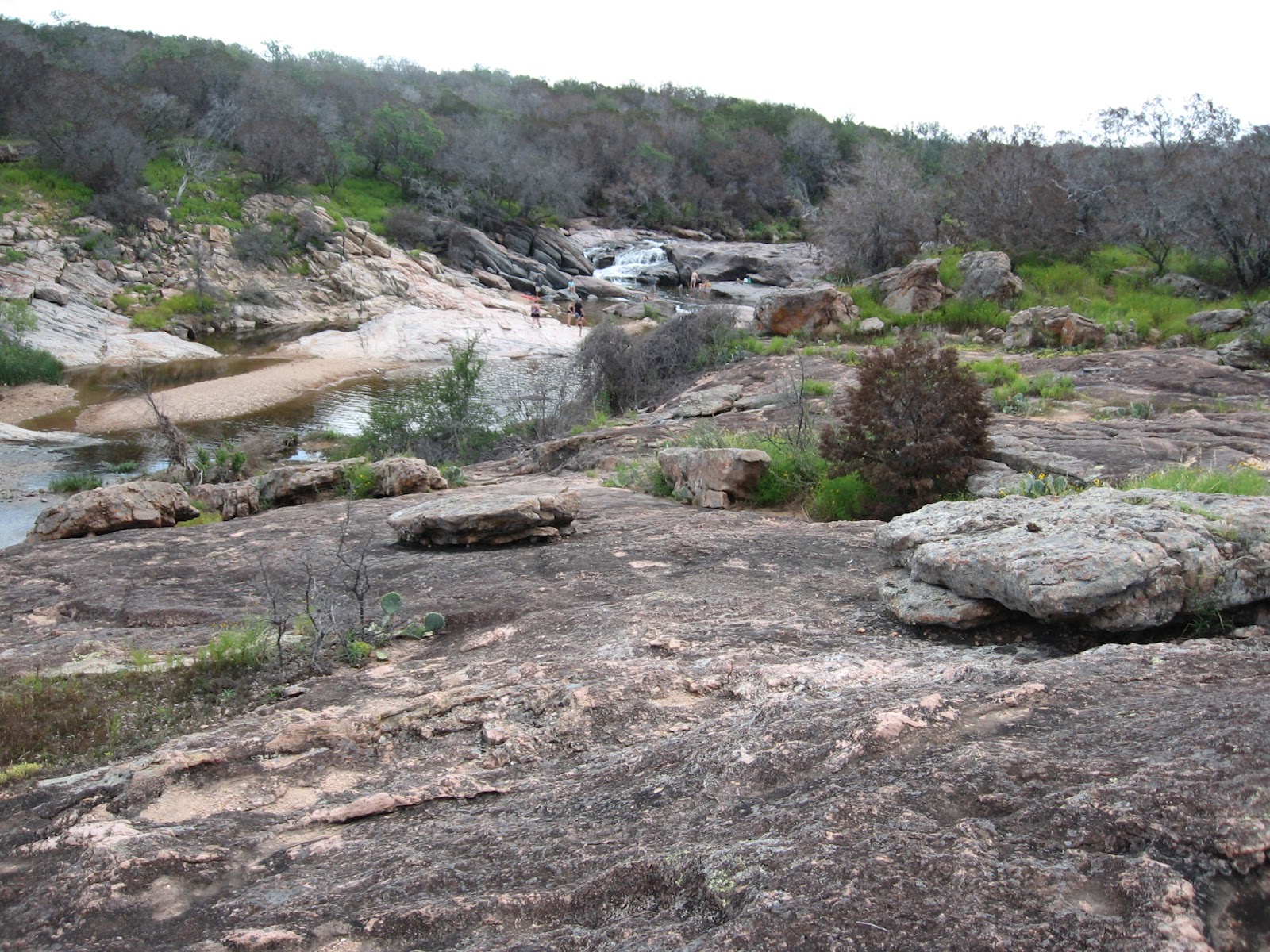
Now before I get on to the visit, I want to talk a bit about an unplanned side trip we had just before reaching the winery. We had gotten a relatively early start and found ourselves with a few hours to kill. Our first stop was Lake Buchanan dam -- as we were coming from Burnet on 29. This didn't provide too much for us -- except for the quartz I scavenged for some future front yard landscaping. It did make things clear that water is an issue up here: the lake bed was there for all to see. What provided a great experience, though, was Perissos' neighbor, Inks Lake State Park. This treasure, just a few short minutes north on 4, was a natural wonder. The rock outcroppings we hiked -- some of the oldest rocks in Texas -- were magnificent. Their colors were a bold swash among the trees, red and orange streaked with black and a hazy, opalescent quartz. The formations were fascinating in their diversity, some jutted out from the landscape and other smoothed down an incline.

Rock outcropping with running water below
We decided to "climb" along these places to put the entire region into perspective. This is a harsh world that must be tended to carefully; in some areas the bare rock faces were radiating the glare of the late morning sun. But of course, the area was not all rock; the lake and its waters run through this scene. So just as I began to notice a trail of sweat forming and feel the sun beat down upon me, I caught a cool breeze right off of the water. The trees that hug the lake offered a respite from the sun drenched rock landscape. And the water itself provided a refreshment to ease my mind. This is an excellent example of the environment the grape growers struggle and relish here. My short hike to the Devil's Waterhole and through the vicinity put me in the best frame of mind for tasting wine. Next time, I am hoping to stay longer, and I would encourage others visit here too.

Tree lined lake front at Inks Lake

A row of my favorite, Makbec @ Perissos
From there, we drove the short trip down the road to the winery, missing it at first because we didn't realize it was so close. We still arrived early, so we wandered through the grapes. It was nice to spend time walking along the grapes. My favorite part was that they were clearly marked. Not only could I get up close to the vineyard, but I could learn which grapes were which. I wish I was visiting now, watching the darker grapes change color and take their full shape, but even seeing how they bunch and the vine grows was new knowledge I happily took in.

When we got to the door, we were ushered in by Baron. He trodded along with us, happy for our attention and the cool stone floor of the tasting room. As I mentioned early, labeling was the task for the day, and one of the vineyard's whites was getting tagged. But our attention was quickly on the wine as Ray helped us through our wine tasting. Ray's enthusiasm for the wines was wonderful; even as the room got busy and he was struggling to help four groups, he kept smiling and chatting away with pride. And Perissos has something to be proud of. They focus on growing their grapes themselves. The vineyard I had just walked through helped create most of the wines I tasted. Now, like most Texas wineries, their vineyard was not enough, but unlike many others, Ray proclaimed with pride that all of Perissos' grape were 100% Texan, getting some from other Texas vineyards.

Inside the tasting room looking towards the door, and Charlie
The wines are much more than their grapes. Among the whites, the Roussane and Viognier blends were standouts. These crisp wines were refreshing after our hike. The went down smooth and made me feel cool. The reds, though, were strong contenders. Anyone who has been reading the blog knows I, like so much of Texas, am fond of Tempranillo. At Perissos, the Temp blend (with a bit of Touriga) is a spicy, yet fruity character. The bold spice of the Tempranillo is there, but it is mellowed and smoothed out by the more fruity nature of the Touriga. I have slowly come to like Touriga, despite not being a big Port drinker (main grape used in traditional port), but I have come to respect its dry fuitiness that is often lacking in so many grapes. And paired with a Tempranillo, the blend becomes well rounded. But the prize winners are their sold out Petite Sirah (I am glad I still have a bottle) and the Syrah blend. And recently, I found a small stash for sale at Vinously Speaking in San Antonio (along with the Tempranillo). These reds are big and complex. The wines exude depth: the terroir comes through with its mineral strength, like my rock outcroppings, and lush flavors, like the lake fed hills. These are wines we had to savor and allow to sink into us.

Bottling paused at Perissos.
 As we sipped through these wines, we learned about the vineyard and the soul of the winery, as much as Ray could squeeze in between pouring and explaining wines for four different groups. The folks here chose their name carefully; Perissos is a Greek term referring to getting what you want, maybe even getting the ideal. At Perissos, we found the ideal. The wines were perfect, matching the lands they came from. The company was wonderful; Ray was friendly, informative, and fun, but Baron, and later Charlie, stole my heart. They are top on my list for a repeat visit. I think I may make a whole day of the park and the winery.

The grapes at Perissos, mid-May 2012