Showing posts with label Northern Texas Hill Country. Show all posts

Wednesday, June 20, 2012

26. The "Twin" Wineries: Pillar Bluff and Texas Legato

26. The "Twin" Wineries
Pure Hill Country
Grape vines wrap around,
cradle a humble refuge:
effortless, wine flows.

Hill Country Song
Carefully they move,
crisp, light shifts to deep and dark:
a wine symphony. 

A word of warning: This is a long entry. I was compelled to write about the two wineries -- Pillar Bluff and Texas Legato -- together. This was due to the strange and fascinating connections the two share.

The last day of our wine trip in the Northern Hill Country found us visiting two distinct wineries with a common heritage. Pillar Bluff and Texas Legato present a different take on wine, from the wine to the bottle. Despite such differences, the two wineries (around the corner and within sight distance of one another) are owned by twins. This provided a unique and exciting wine experience.

The vineyards at Pillar Bluff
Texas Legato


The Twins' Shop: Drops of God, Vol. 2
I first want to talk about the twin thing. Heather, at Pillar Bluff, made it clear that these were very different men. Gill Bledsoe (at Pillar Bluff) spends as much of his time as possible tending the grapes and making the wine. He lives and breathes the whole thing. Bill Bledsoe (Texas Legato) is equally in love with this endeavor; when we were there he was intimately involved. However, this is his weekend job. During the week, he knows the professional world like most of us (I could easily relate). I think their philosophies -- simplicity and complexity -- derive from this. But for me, the most interesting part of this all is the connection to my current favorite comic, Drops of God. 

The Twins: Drops of God, Vol. 2
 One of the main characters, Miyabi, grew up with a pair of twins, Kenya and Junya Ishikawa. Their father owns a wine store that is to passed down to the both of them. Like Gill and Bill, they approach wine differently. One brother is more sophisticated; his appearance is sharp, crisp, and professional, and he focuses on premium wines. The other brother is a former bosozoku -- a biker gang member -- that still retains a bit of that style, the more denim themed clothes and a bit of a 50s throwback (even a pompadour). He wants to find the best wine at the best price, to make it available and enjoyable for all. Though their appearances didn't match, the idea of twins with different takes on wine piqued my interest.

 We started at Pillar Bluff, owned by Gill, after a supportive recommendation from family friends Steve and Kathy Feinstein (see there music work with Fein Tuned and The Tim and Bob Show). We arrived to a small and cozy tasting room; I was grateful, due to size, that we were the only ones there. Heather, who works the tasting room during summer break, greeted us as we entered and welcomed us to taste and chat. We felt very welcome here and enjoyed the conversation as much as the wine. We were told us about Gill but also Bill. We gained insight into the the history of the winery and Gill's philosophy. Then we found the most interesting news of the day: we all attended the same college and studied the same degree for at the same time. Well, that lead to a lot of reminiscing too.

As for the wines, they are simple. Gill seems to be a bare bones sort of guy. He dedicates himself to every aspect of the wine, from the grapes to the wine. The dedication shines through the wine. The MOST perfect example is their 2009 Double Gold Merlot. This wine is deep and complex, more akin to a Cabernet Sauvignon than a Merlot. The color is deep, and the aroma drifts up and hints at the wines subtle flavor. And that is just how it starts; there is a subtle development of flavors until a penultimate point is reached. Here the wine plateaus, and the flavor is rich with fruit that doesn't have much of a sugary feel. The undertone is earthy, but it doesn't get taken over by the mineral nature of most Texas wines. It ends smooth. When I opened my bottle after a bad day about a week back, it seemed to sink in and relax everyone of my muscles. Another stand out was the Tyler, a Rhone style blend. This wine, named for a family member, was more luxurious and closely resembled its French counterpart.

Outside at Pillar Bluff
Before leaving, we did take a bit of time to explore the grounds. Now, despite the small tasting room, the outside had a beautiful open pavilion in a circular form. This area had both an air of classicism and local flavor. It was classy and comforting. Too bad the sun was high in the sky and starting to bare down on us, otherwise sipping on a glass of wine in this peaceful landscape would have been wonderful.

After leaving, we drove around the corner to Texas Legato. This tasting room was homey, obviously made to be a home away from home for the owners. The inside seemed a bit kitschy or over-the-top at first glance, but the friendly greeting and the rapport of everyone there made it seem natural. Now I have to admit that it felt a bit tight and anxious during our visit, but that was because they were bottling when we arrived. The tasting room had a section that was stacked high with newly bottled wine, as well as the extra seating area over taken by labeling. Many of the folks at Texas Legato were running around between the back -- where they were bottling -- and the front. Despite all the activity, time was made to sit down and welcome us. We were even invited to the back to see the bottling firsthand.
At the tasting bar at Texas Legato

It was made clear that this was an example of a small winery bottling. The process was simple. One person took the bottles, usually two at a time, and placed them on a rod that shot water up into the bottle; this effectively cleaned the bottles. This, on occasion, often resulted in the person getting wet. Then the bottles moved through the makeshift assembly line to be filled. Wine was passed through a large steel container into the bottles. Though it seemed the machine knew what it was doing, Bill, who was operating it at the time, often had to check to make sure that enough was put in. Then the bottles had a cork inserted into them. After that, a covering was placed over the cork. The final step looked like placing the lengthwise portion of a hair dryer over this top. This strangely familiar looking tool sealed the material to the bottle. From there, bottles were boxed for labeling, and unlike at Perissos earlier in the day, they did this by hand. NOTE: if you want to see a larger wineries production in the hill country, I would suggest Duchman in Dripping Springs.

Blurry picture of bottling at Texas Legato

As for the wines, these were a more complex array. Blends and less common varietals (compared to the nearby wineries) were the offering. It seems that Texas Legato likes to provide a more complex wine. This is very easy to see in the more complicated and detailed labels (as compared to Pillar Bluff). The blends, such as the Family Reunion, and the ports were the standouts here. The Family Reunion was a bold complex blend that matches the larger wineries (especially the HWY 290 ones) similar red blends. It was rich and bold. As for the ports, well, they are a delight. I am not a port drinker; I often find them too sweet. My husband loves port; he would fit into the traditional formal meals found in Regency and Victorian England (you can also get a feel for it by watching Downton Abbey). The ports here were drier, mellowing the sweetness. But by doing that, other richer flavors came out. Instead of a strong sugary taste, I tasted other flavors, the berry and more earthy flavors. And with Texas Legato's port sippers, those flavors came bursting through.

After these last two visits, we were quite sated, and it was both easy and hard to make the long drive home. We had found two wonderful little gems. The wineries provided some of the most exciting wine and visiting experiences. We knew we had found the great time we had been looking for, and so felt comfortable heading home. On the other hand, these were wines we want more of; these are wineries we want to visit more. This made it very hard to leave. And of course, we are definitely planning on going back.

Tuesday, June 12, 2012

25. The Drought: Sanctuary at Perissos Vineyards (and Inks Lake State Park)

25. The Drought: Sanctuary at Perissos Vineyards (and Inks Lake State Park)
Crafted by sunshine:
grasses and trees pull away
leaving only rocks.

The oasis runs through it:
sparkling lakes feeding grape vines.


Day two of our Northern Hill Country wine trip started at Perissos Vineyards. While we were there, things got busy. When we arrived, there was labeling going on, but not much else (even visitor wise). Before we were half way through our tastings, three more groups had arrived and were enjoying the wine too. And in the small tasting room, with two great big dogs lounging to escape the heat, it all seemed a bit snug. That didn't matter with such good wine to attract our attentions.

The shrinking lake at Lake Buchanan Dam


Inks Lake State Park


One of the rock faces at Inks Lake
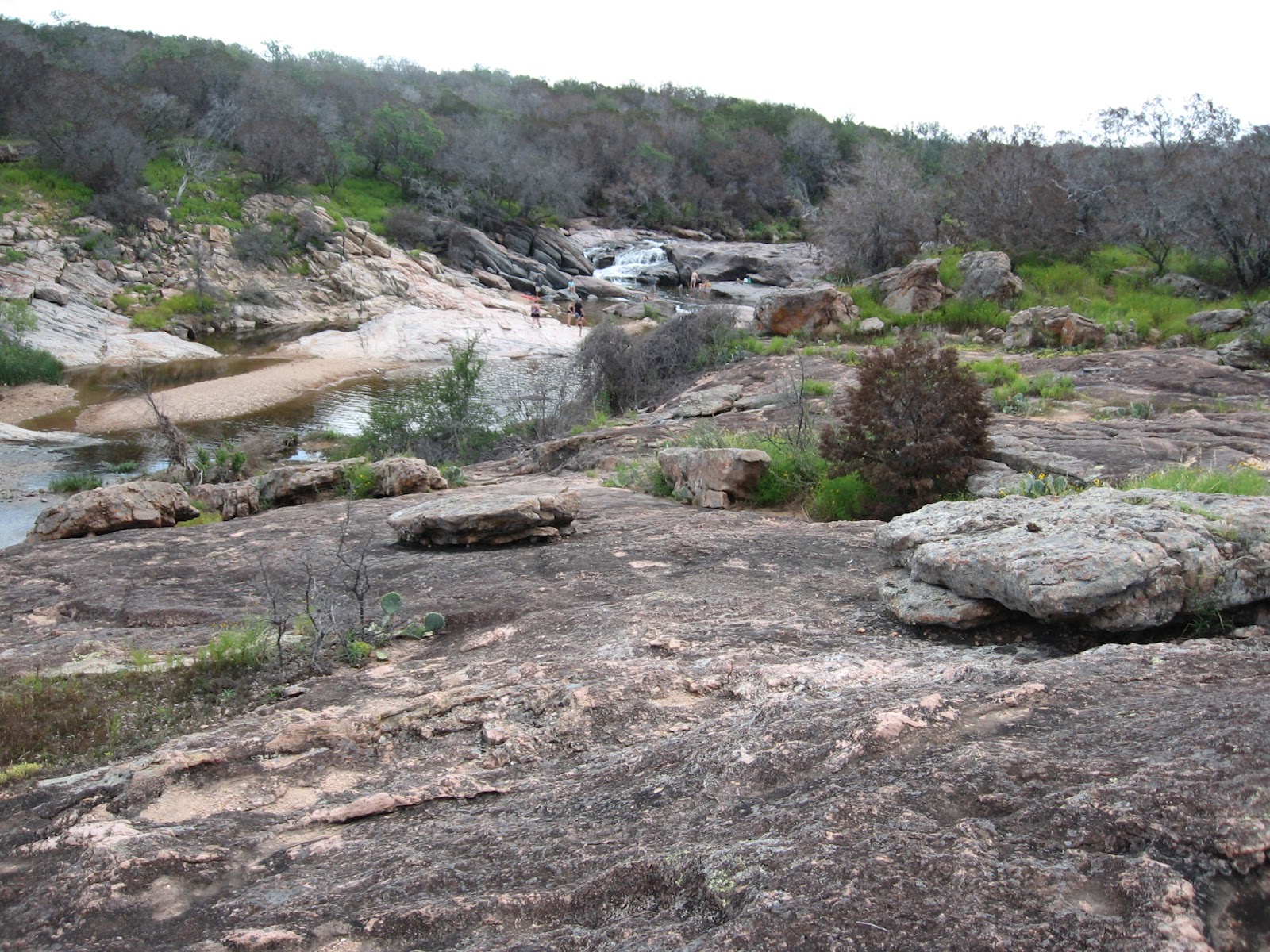
Now before I get on to the visit, I want to talk a bit about an unplanned side trip we had just before reaching the winery. We had gotten a relatively early start and found ourselves with a few hours to kill. Our first stop was Lake Buchanan dam -- as we were coming from Burnet on 29. This didn't provide too much for us -- except for the quartz I scavenged for some future front yard landscaping. It did make things clear that water is an issue up here: the lake bed was there for all to see. What provided a great experience, though, was Perissos' neighbor, Inks Lake State Park. This treasure, just a few short minutes north on 4, was a natural wonder. The rock outcroppings we hiked -- some of the oldest rocks in Texas -- were magnificent. Their colors were a bold swash among the trees, red and orange streaked with black and a hazy, opalescent quartz. The formations were fascinating in their diversity, some jutted out from the landscape and other smoothed down an incline.

Rock outcropping with running water below
We decided to "climb" along these places to put the entire region into perspective. This is a harsh world that must be tended to carefully; in some areas the bare rock faces were radiating the glare of the late morning sun. But of course, the area was not all rock; the lake and its waters run through this scene. So just as I began to notice a trail of sweat forming and feel the sun beat down upon me, I caught a cool breeze right off of the water. The trees that hug the lake offered a respite from the sun drenched rock landscape. And the water itself provided a refreshment to ease my mind. This is an excellent example of the environment the grape growers struggle and relish here. My short hike to the Devil's Waterhole and through the vicinity put me in the best frame of mind for tasting wine. Next time, I am hoping to stay longer, and I would encourage others visit here too.

Tree lined lake front at Inks Lake

A row of my favorite, Makbec @ Perissos
From there, we drove the short trip down the road to the winery, missing it at first because we didn't realize it was so close. We still arrived early, so we wandered through the grapes. It was nice to spend time walking along the grapes. My favorite part was that they were clearly marked. Not only could I get up close to the vineyard, but I could learn which grapes were which. I wish I was visiting now, watching the darker grapes change color and take their full shape, but even seeing how they bunch and the vine grows was new knowledge I happily took in.

When we got to the door, we were ushered in by Baron. He trodded along with us, happy for our attention and the cool stone floor of the tasting room. As I mentioned early, labeling was the task for the day, and one of the vineyard's whites was getting tagged. But our attention was quickly on the wine as Ray helped us through our wine tasting. Ray's enthusiasm for the wines was wonderful; even as the room got busy and he was struggling to help four groups, he kept smiling and chatting away with pride. And Perissos has something to be proud of. They focus on growing their grapes themselves. The vineyard I had just walked through helped create most of the wines I tasted. Now, like most Texas wineries, their vineyard was not enough, but unlike many others, Ray proclaimed with pride that all of Perissos' grape were 100% Texan, getting some from other Texas vineyards.

Inside the tasting room looking towards the door, and Charlie
The wines are much more than their grapes. Among the whites, the Roussane and Viognier blends were standouts. These crisp wines were refreshing after our hike. The went down smooth and made me feel cool. The reds, though, were strong contenders. Anyone who has been reading the blog knows I, like so much of Texas, am fond of Tempranillo. At Perissos, the Temp blend (with a bit of Touriga) is a spicy, yet fruity character. The bold spice of the Tempranillo is there, but it is mellowed and smoothed out by the more fruity nature of the Touriga. I have slowly come to like Touriga, despite not being a big Port drinker (main grape used in traditional port), but I have come to respect its dry fuitiness that is often lacking in so many grapes. And paired with a Tempranillo, the blend becomes well rounded. But the prize winners are their sold out Petite Sirah (I am glad I still have a bottle) and the Syrah blend. And recently, I found a small stash for sale at Vinously Speaking in San Antonio (along with the Tempranillo). These reds are big and complex. The wines exude depth: the terroir comes through with its mineral strength, like my rock outcroppings, and lush flavors, like the lake fed hills. These are wines we had to savor and allow to sink into us.

Bottling paused at Perissos.
 As we sipped through these wines, we learned about the vineyard and the soul of the winery, as much as Ray could squeeze in between pouring and explaining wines for four different groups. The folks here chose their name carefully; Perissos is a Greek term referring to getting what you want, maybe even getting the ideal. At Perissos, we found the ideal. The wines were perfect, matching the lands they came from. The company was wonderful; Ray was friendly, informative, and fun, but Baron, and later Charlie, stole my heart. They are top on my list for a repeat visit. I think I may make a whole day of the park and the winery.

The grapes at Perissos, mid-May 2012

Thursday, May 31, 2012

22. Siesta: A Visit to Fiesta Winery

22. Siesta
Summer's glaring sun:
hindered by the wine's cool breath,
lessened by a hint of sweet fruit.

I will relax here awhile.

Entrance to Fiesta Winery

The end of my first day in the Northern Hill Country took my husband and I to Fiesta Winery. We were told to expect something different. In fact, this region is very happy that the wineries are all a bit special, a bit different from one another. Fiesta, expect to settle in and relax. From the setting to the wines, this is a place to just sit back and take it easy.

When we arrived, we were encouraged to find a table. Only one other table was occupied, a group that had just finished their tasting and was having lunch. We skimmed over a menu of the wines, trying to decide which ones to taste. We were also supplied a score sheet of sorts. On the sheets, we listed our choices (to help the person serving us) and later used them for comments.  I have to admit, I like when wineries give guests something with the wine names and places for comments; it helps to make informed purchasing decisions. We meandered through the wine list and chose an eclectic lot – as the wines here are not the normal fair). From them on, we strolled through the wines, drinking at our own pace. And of course, seated at a table provided a chance to privately share our thoughts and easily take notes.
Inside Fiesta Winery

All that being said, I have noticed a drawback to this sort of set-up. At first glance, the seated and served tasting seems relaxed and nice, but after the visit here, and later at Woodrose Winery the next week, I am beginning to wonder. I always look for a memorable wine experience; I hope to get involved with the wine or the winery – a good example is our chat with Jim Johnson just before our visit to Fiesta (see A Northern Hill Country Landscape -- Visiting Alamosa). I want to take a way something special. This special experience  can be hard in more service-like setting. The person serving the wine has to work harder. It is easy to strike up a conversation and socialize at a bar; there is a natural sense of camaraderie while both parties saddle up at the bar, gaining crucial eye-to-eye contact. At a table, this can be achieved only one of two ways: either sitting down at the table with the guests or just hanging around the table (like many top wait-staff do). Unfortunately, most times I visit wineries like this, no matter how well meaning the folks are, something seems to draw their attention way and keep them from crossing the barrier created by the table. At Fiesta, I realize it was a lazy Saturday afternoon without much going on, and I also realize that Sally was probably busy increasing the presence of Fiesta online, but it wasn’t the homey, welcoming experience I expected (an expectation created by visiting their website).

So, with the tasting underway, the focus quickly turned to the wine. The wines here are almost entirely blends (which can be a VERY good thing), and not the traditional sort. Most of the wines are blended with fruit. This is interesting when it works. The Rhinestone Cowgirl is one of these. This blend of Pinot Gris and Malbec (that single word always piques my interest) is blended with cranberry and prickly pear. The resulting blush is a gentle, sweet fair that is more like a pleasant fruit drink or cocktail. The drawback here is that it isn’t much like wine.

The vineyard just outside the tasting room
That isn’t to say that there aren’t good wines. Fiesta has followed the new Texas tradition and has a solid Tempranillo. This one feels very Spanish, spicy and earthy, the taste of tobacco and leather is powerful; the spice though adds a depth that doesn’t weigh down the drinker. We were told this was the winemaker’s favorite, which is no surprise. This Tempranillo didn’t taste like the Fall Creek one we had the night before (that one was subtle and smooth) or like the Tempranillo blends at Alamosa. Instead, it was robust and swarthy. I could almost imagine a Spaniard, straight from the vineyard, sweat beading on his sun-darkened, resting under a large tree sipping at this wine.

In the end, we lazily moved through our selections, both happy to end with the robust Tempranillo. Inside the cozy ranch-house like tasting room, we watched the sun blaze down on the grounds around us. This little stop is a nice place for escaping the summer heat, from the seating to the wines.

Wednesday, May 30, 2012

21. At Attention: Visting Fall Creek

21. At Attention: Visiting Fall Creek
Each branch, a sword,
each leaf a tasseled honor:
these trees stand ready.  

I dared not touch any grapes
for fear the trees would take me.


Drive up the tree lined path

Fall Creek was the first winery on my Northern Hill Countrylist. I have seen them around for years, as they often dominate the shelves whereTexas wines are sold. I also got my first real taste of the vineyard at theTexas Hill Country Wine and Music Festival. The wines hinted at solidwine making, so I was curious. I had high hopes for the first stop on myNorthern Hill Country tour.

View at Lake Buchanan Dam
First, I was in store for a trip I did not expect. Going to Fall Creek (from the South) is a journey, one that provides a lot to view. We drove up along Lake Buchanan, which provided a majestic view for most of the trip. However, it was only its former glory; at closer inspection, the lake is obviously the victim of the drought. At Lake Buchanan Dam, this is most apparent. We walked out where once the lake stood, shuffling through rocks,shells, and sandy grasses. Despite the low water levels, the lake was just off to the right most of the time.

 Also, as we drove, we realized that even late May has its share of wildflowers, at least up here. The road was lined with blankets of yellow; dispersed in the yellow was a bold red and clusters of startling purple. This wonder of fauna led us straight to a tree lined path. This spectacular sight greeted us and shaded us all the way up the winery. The canopy of large trees felt more like driving up an English country lane rather than a path to a Texas winery. The vineyards, flanking the trees, did match though. At the end of the path, the visitor is aware of arrival: one of the winery buildings is centered perfectly at the head of this trail, welcoming the guest in.

Fall Creek grapes as of May 20
On our arrival, we wandered around outside a bit. Right now,the grapes are starting to grow, small, green, and tightly clustered; we saw bunches hanging from the leafy vines. Honestly, it was nice to get up that close. From most of my experience, the vineyards are off a bit, a sight to view from a distance. Here began a trend I saw through most of this region, the vineyards are right there – the parking lot is sandwiched between the tasting room and the vineyard. This closeness was a nice touch and allowed me to see just how far along the 2012 crop was.

Looking on to the patio area
As for the winery, it is a welcoming place, open and yet not empty. The outside patio is a great touch, harkening to patios in great Spanish and Italian homes. Despite the strengthening sun, shade fills the space in a most pleasing way. But of course, the tasting room stands out. The tasting room is a shrine to Fall Creek’s success. Their many ribbons are out for viewing, as well as awards hidden on shelves and accolades lining the walls. This is a place that has been working hard with wine, and they have earned their praise;it is no wonder they want to show it off.

And that leads right to the wine. This wine here is solid;every taste is catered to in some fashion, and everyone should be able to find a wine that really pleases. The best part is the price. This winery has been around for a while (late seventies), and so they have had time to build up;this allows them to have wines within every price range – they start at around6 and head into the 30s. We spanned the gap, making sure to take home their 2009Tempranillo; it wasn’t available for tasting, but we had some the night before where we were staying and really enjoyed it. We also took home a new wine, a Muscat with a hint of Chardonnay. The blend softens the Muscat sugars and makes a smoother sweet wine.

The wine was a stronger pleaser – the whites provide crisp refreshment and the reds are smooth and deep. However, I guess I caught the folks at Fall Creek off guard. We arrived at opening on a Saturday and were the only people there (not something I am at all used to, as Saturdays get going early along 290). Most of the staff seemed preoccupied with various chores, and so we were left to one of three people there. Our steward for the tasting was a friendly and affable sort but was limited on his knowledge of wine (and even to some extent, Fall Creek); I am a red drinker, and he admitted he really didn’t know much about the reds. In the end, there was little to talk about, something I ama bit disappointed by. Unfortunately, this was similar to the experience I had at the festival. The Fall Creek representatives were approachable and polite, but they didn’t see eager to chat. I hope this is not a common occurrence, as Iwould love to really enjoy a winery like this – it has history (to see, checkout Spectaculars Wineries of Texas and The Wineslinger Chronicles), it is beautiful (and I didn’t even get to see the fabled Fall Creek falls), and the wine is good. If anyone has other experiences, I would love to hear about them and who I need to contact.

I left Fall Creek a bit torn. When I drove up, I felt like I was entering a magical place where wine came to life, a place that was a swath of heaven in a drought ridden landscape. The wines were as good as I was promised. I knew these were wines I would pour for friends that were just starting to get into Texas wine (the wines are pleasing, welcoming, and inexpensive). I happily bought one of the most expensive wines available. However,I didn’t feel as welcomed as I do at so many other Texas wineries. At so many,visitors, new and old, are greeted as if they were always friends. If it isn’t too busy, there is always time for a history lesson or an exploration of what wine is to this winery. I just didn’t get that, and I was a bit disappointed. I hope that will change on my next visit.

Tuesday, May 29, 2012

20. Northern Hill Country Landscape -- Visiting Alamosa Wine Cellars


Purple horsemint in the Northern Hill Country
20. Northern Hill Country Landscape
Purple horsemint fills
a blanket of wild yellow
broken by cacti hills:

A horny toad greets me here
with stubborn, bold swirls of wine.


I have to say that I am very glad I made the trip to Alamosa Wine Cellars. This out of the way place – part of the Hill Country wine trail and the Way Out Wineries trail – is a gem hidden in the northern hill country. In fact, this was everything I want in a winery: great wine, neat set-up, and great company.

Alamosa Cellars
When Sean and I first stepped in, we were greeted by the winery dog. He welcomed us in quickly – offering a belly to scratch. A little bit of time with a friendly pet passes the time well, which we needed because the small tasting room (with only winemaker Jim Johnson at the bar) was packed. A calm friendly welcome was a good sign. We relaxed until the crowd moved out, and we were rewarded with a long, meandering tasting and chat with winemaker Jim Johnson. He is a fount of wine knowledge, especially Texas wine knowledge.

Looking at the front of the tasting room.
On the side of the tasting room


First, the wines are great. I tasted much of the selections and was pleased with everything. The reds here are a BIG score. The El Guapo is an exciting blend that is held together well by Tempranillo – a neat tidbit learned is that Alamosa pioneered this grape in Texas, which is quickly becoming one of Texas’ best grapes. The other grapes used add complexity to the wine, a trait many of the wines share, especially the 2006 Port. These blends really matched the landscape. The odd collection of plant life seems to blend and mix seamlessly here – wildflower, prairie grasses, and cacti bundled together in waist high fields that stretch along the hills. As far as the eye can see in the northern Hill Country (in spring), one can see a variety of colors and textures that create a distinctive and complex landscape.
A Northern Hill Country landscape
Beyond the complexity of the landscape is the various nature of it. Depending on the direction one looks, the same elements – hills, rock outcrops, wild flowers, and sun – combine in different ways to create different views.  If I look one way, I may see rolling hills and soft wildflowers, another way may be jutting rocks with sparse flowers peeking out of a few spots, and then there are the spots that are parched from the heat of the Texas sun. The same goes for the blends at Alamosa. Most of the blends rely on the same sorts of grapes, but the proportion and technique used to fashion them from grape to wine creates variety of flavors. And with summer’s heat creeping back, I recommend the blush – Mouverdre never tasted so smooth.
Views of the vineyard.

What was best about the winery was the company. Jim had great insight – he warned me that my grape vine will likely be struck by Pierce’s  disease – as many vines here are. He then encouraged me not to give up growing, suggesting Touriga or Blanc du Bois, as they are rather hearty and easy to grow in Texas. Besides great wine lessons, especially about what will grow well here in Texas, he had great stories. I had already heard some funny tales about Dr. Becker (from Becker vineyards), but now I was getting it from one of the former Becker winemakers – the staff there never knows what Dr. Becker gets into (he is very hands on) until they find the mess later. This is both a frustrating story and a charming one.

Views of the vineyard.
The best of the stories was about the raccoon. They were unloading Grenache recently brought in from Mason when the grapes got loose and fell. Well, they salvaged what they could, but had to leave some behind – no one wants gravel with their wine. The grapes began to ferment under the late August sun, being one of the hottest times of the year. Then one night, Jim found a ball of fur where the grapes should be. He went up and discovered a very drunk raccoon. The raccoon had been feasting on the fermented grapes and looked up at Jim with that relaxed stare we all get from time to time. So, even Texas wildlife likes Alamosa wine. And if anyone’s interested, this wine can be found in the 2002 port.

Before leaving, we also got to meet Karen, Jim’s wife and an active member of the Texas wine world. She encouraged us to come back out for the WOW (Way Out Wineries) event at the end of June. The details were intriguing – a sample of wine (in a WOW stemless glass keepsake), a sample of each wineries’ chosen cuisine, and judging. Her enthusiasm was contagious, which makes the drive out to Alamosa worth it.

In fact, if Alamosa was the only place I visited, I would have left happy. I felt welcome at Alamosa, but I also learned so much. And the best thing I learned, I was missing out on some great wines.Even as I write this, I am enjoying my bottle of Texacaia. This wine, labeled as their Super Texan, is a smooth and balanced blend of Sangiovese, Tannat, and Petite Verdot. This wine is the late evening warmth, the heat of day waning in the summer dark. It is rich and full, deep and dark like the promise of the night. The warmth and spice of the day hints just above the rich flavor that saturates everything. I am so glad that the sun is setting, but another day for Alamosa is just past the horizon.